Filtreler
Gizle/Goster
ID: 14247
Exam: 1077 | Row: 10
No image
No image
How should you stay alert and prepared for potential hazards on the road ahead?
Choices
1
Continuously scan the entire road and surrounding areas.
2
Keep your eyes fixed straight ahead at all times.
3
Rest your left foot lightly on the brake while driving.
4
Focus mainly on the center of your lane.
ID: 14257
Exam: 1078 | Row: 10
No image
No image
When passing another vehicle, you must
Choices
1
return to the left side of the road before coming within 100 feet of an oncoming vehicle.
2
return to the left side of the road before coming within 200 feet of an oncoming vehicle.
3
return to the right side of the road before coming within 200 feet of an oncoming vehicle.
4
return to the right side of the road before coming within 100 feet of an oncoming vehicle.
ID: 14267
Exam: 1079 | Row: 10
No image
No image
Proactively looking ahead, to the sides, and behind your vehicle to anticipate problems ahead is part of
Choices
1
distracted driving.
2
defensive driving.
3
aggressive driving.
4
disciplined driving.
ID: 14277
Exam: 1080 | Row: 10
No image
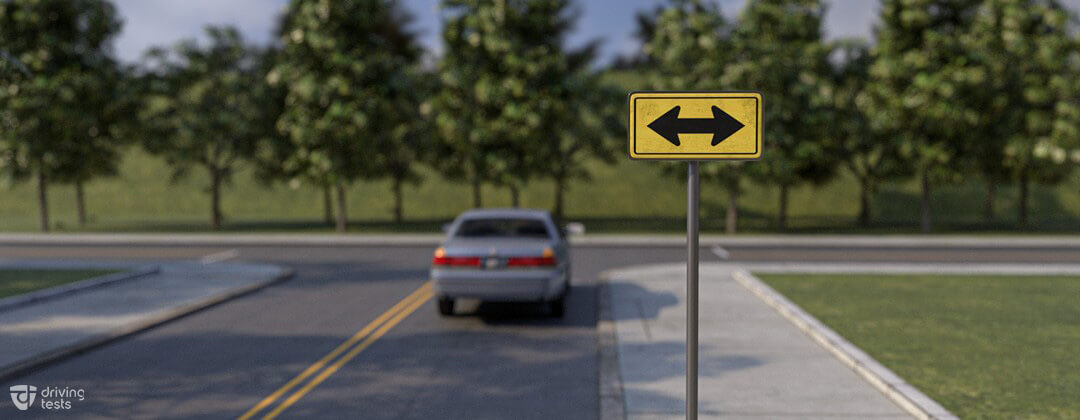
What does this sign mean?
Choices
1
The roadway is closed on both sides.
2
A divided highway ends ahead.
3
A divided highway starts ahead.
4
You must yield the right-of-way or stop before turning right or left.
ID: 14287
Exam: 1081 | Row: 10
No image
No image
At an intersection where there are no stop signs or traffic signals, you must yield to
Choices
1
vehicles coming from the right.
2
vehicles proceeding straight ahead.
3
vehicles approaching from behind.
4
vehicles coming from the left.
ID: 14297
Exam: 1082 | Row: 10
No image
No image
Things that can distract you from the road include
Choices
1
always checking mirrors.
2
checking the traffic behind you frequently.
3
text messaging and talking on the phone.
4
checking blind spots.
ID: 14307
Exam: 1083 | Row: 10
No image
No image
Which of the following statements about lane markings is true?
Choices
1
A double solid yellow line between opposing lanes of traffic means that either side can pass.
2
A solid white line between lanes of traffic means that you should stay in your lane unless a special situation requires you to change lanes.
3
Where there are both a solid yellow line and a dashed (broken) yellow line between opposing lanes of traffic, you may pass if the solid line is on your side.
4
A dashed (broken) yellow line between opposing lanes of traffic means that you may not cross the line.
ID: 14317
Exam: 1084 | Row: 10
No image
No image
Stopping on the pavement or shoulder is only allowed
Choices
1
to pick up or let off passengers.
2
to make a right turn.
3
to make a left turn.
4
in an emergency or when your car is unable to go any farther.
ID: 14327
Exam: 1085 | Row: 10
No image
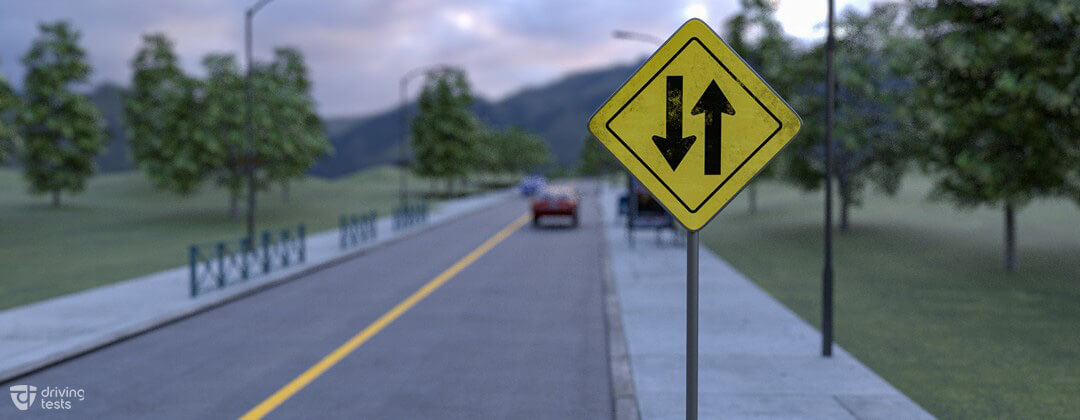
What does this sign indicate?
Choices
1
A one-way road is ahead.
2
A no-passing zone is ahead.
3
No traffic is allowed in the directions shown.
4
A two-way road is ahead.
ID: 14337
Exam: 1086 | Row: 10
No image
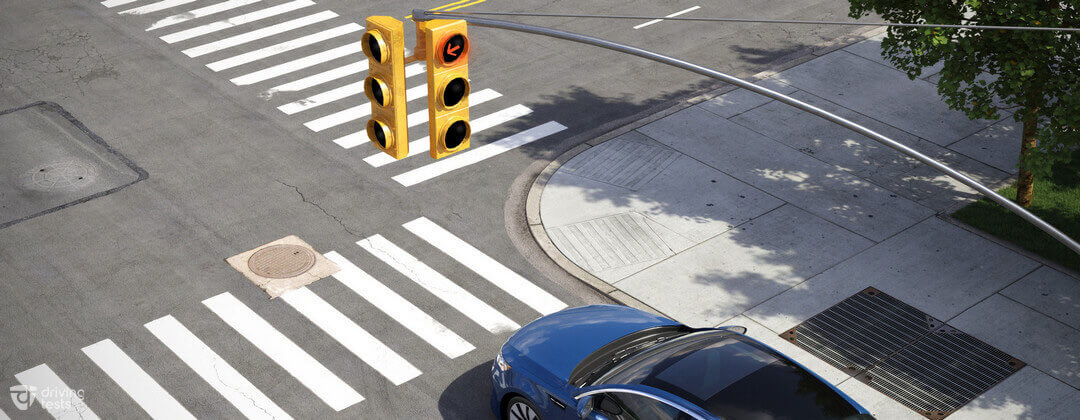
A red arrow at an intersection indicates that
Choices
1
turning traffic must increase speed and turn quickly.
2
turning traffic must proceed at the same speed.
3
turning traffic must stop.
4
turning traffic must slow down.